
希腊债务危机与中国有关吗?
中国强大了,总有人喜欢把什么样的“屎盆子”都往中国头上扣。我在《华尔街日报》中文版上看到一篇文章,说是加利福尼亚大学(University of California)圣地牙哥分校的经济学教授James Hamilton在其Econbrowser博客上称,中国与欧洲主权债务危机之间存在有意思的联系。Hamilton指出,希腊国债收益率在今年春天大幅上升,是引发主权债务危机的导火索,而这与中国在早些时候为抑制经济过热而采取的紧缩措施不无关系。
后来我查看了原文,得知Hamilton是这样写的:The developments in Europe have coincided with efforts by
国际学术界对希腊危机的根源早已有定论,即政府公共财政的长期入不敷出、庞大的债务负担以及货币政策的缺失。在国际金融危机的冲击下,这些内部因素终于演变为举世瞩目的危机。 希腊危机不是中国造成的。中国在希腊遇到危机后甚至出手帮助。James Hamilton教授在其大作中却没有提到这一点。但愿是他不知道,而非故意不提。
Analysis of current economic conditions and policy
November 30, 2010
Europe and
The autumn of 2010 is in some ways a replay of what we saw last spring. Is what we saw then a guide to what's going to happen next?
Last spring the yield on 10-year Greek sovereign debt spiked up 600 basis points as concerns rose about the country's ability and willingness to meet future interest payments. After a significant bailout from other European countries and the IMF, yields settled back down. They crept back up this summer, fell in September and early October, and are now back up almost to the peaks reached at the height of the crisis.
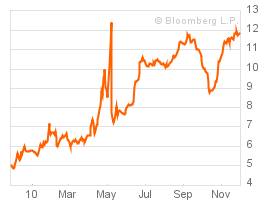
Yield on 10-year Greek government bonds. Source: Bloomberg GGGB10YR
The concern last spring was that problems in
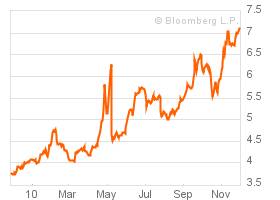
Yield on 10-year Portuguese government bonds. Source: Bloomberg GSPT10YR
As Paul Krugman notes, the really scary thing is that
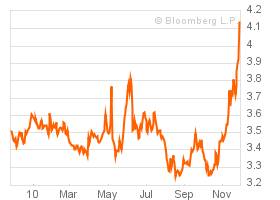
Yield on 10-year Italian government bonds. Source: Bloomberg GBTP10YR
Thus we're seeing last spring's sovereign debt concerns being replayed in slower motion but on a broader scale than the first time around. There's another interesting parallel with last spring's concerns. The developments in Europe have coincided with efforts by China to raise interest rates and tighten credit. And just as we saw last spring, the decline in
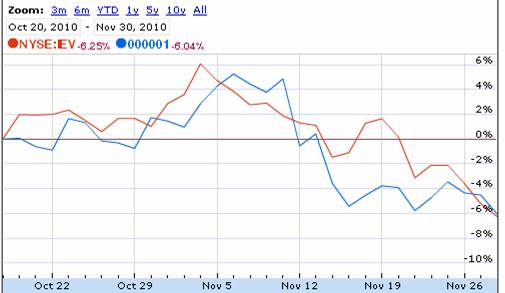
Blue: SSE Shanghai Stock Exchange composite stock price index. Red: IEV S&P Europe 350 stock price index. Source: Google Finance.
If this is deja vu all over again, what might we expect next? What happened last spring was a flight to the dollar as a seemingly safe refuge. And there's been some appreciation of the dollar with the latest events as well, with more to come if history repeats itself.
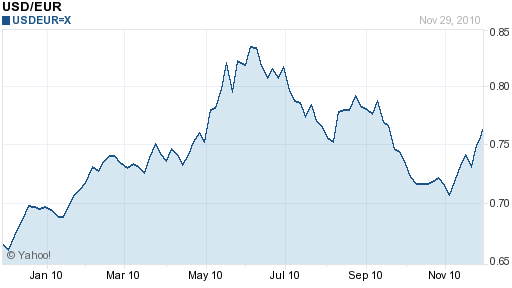
Exchange rate in euros per dollar. Source: Yahoo Finance.
But this is a slower-moving and broader wave than the first one. And tsunamis pack much more power than a simple crashing breaker.
中国与欧洲债务危机脱不了干系?
中国与欧洲主权债务危机之间是否有关联?
加利福尼亚大学(University of California)圣地牙哥分校的经济学教授James Hamilton在其Econbrowser博客上提出这两者之间存在有意思的联系。他指出,希腊国债收益率在今年春天大幅上升,是引发主权债务危机的导火索,而这与中国在早些时候为抑制经济过热而采取的紧缩措施不无关系。
中国担心银行信贷规模激增会导致泡沫和引发通货膨胀,因而采取措施为经济刹车。受此影响,中国股市整体回落了25%。希腊主权债务问题正是在此期间浮出水面,希腊国债收益率飙升,并呈现出向整个欧元区蔓延的势头。而到了今年夏初,中国政府担心国内股市大跌会引发更大范围的经济滑坡,于是为提振经济又踩下了油门。与此同时,欧洲对希腊的大规模救助计划也缓解了欧元区的主权债务危机。
然而,随着通胀压力的上升,中国政府被迫再次采取行动给经济降温。尽管大多数措施是以调控物价为目的,但中国也由此开启了加息进程。而自中国政府采取新经济降温措施以来,中国股市已累计下跌10%左右。
巧合的是,欧洲的债务问题也在此期间死灰复燃。在欧元区所有外围国家都有可能被拖下水的情况下,这次欧洲不得不向爱尔兰伸出援手。
诚然,这种联系可能站不住脚。但这之间存在直接联系的可能性肯定是有的,而且传递这种联系的机制或许就是亚洲储蓄严重过剩。美国联邦储备委员会(Federal Reserve,简称美联储)认为,正是这一机制导致了过去15年来全球经济失衡。
如果说在资产泡沫盛行的年代,是过剩的亚洲储蓄压低了各类资产的收益率,并导致美国出现极其庞大的经常项目赤字,那么在这些过剩的储蓄被释放时,自然也会破坏原来的平衡。
不幸的是,虽然全球经济再平衡的最终结果是让国家经济变得更健康,但过程将是曲折而痛苦的。其副作用之一便是主权债务压力增加,换句话说,就是政府举债的成本变得更高。
一些国家已处于破产的边缘,如欧元区外围国家。利率稍有上升都可能将他们推下悬崖。一旦发生这种情况,这些国家的债券将被投资者抛弃,收益率将随之大幅飙升。
若果真是这套机制在发生作用,中国和德国等拥有盈余的国家会发现,手中的外国债券将让他们损失惨重。拿德国来说,这种损失可能来自于免除爱尔兰、希腊、葡萄牙和西班牙的部分债务。至于中国,这种损失更有可能以美元贬值的形式出现。
无论如何,这些国家在全球失衡时代积累的财富的价值将比他们所想的要少得多。
Alen Mattich
http://cn.wsj.com/gb/20101202/ecb150755.asp